



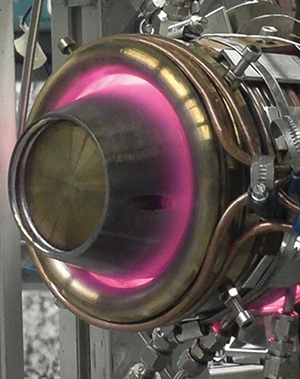
Researchers at the Karlsruhe Institute of Technology (KIT) have demonstrated a hydrogen gas turbine that generates electricity without a mechanical compressor. This is the component that typically consumes around 50% of a conventional gas turbine’s output. The prototype ran for 303 seconds, and earlier this year the team confirmed it had produced electricity, a first for this class of machine.
The achievement addresses a long-standing inefficiency in gas turbine design. In a conventional turbine, whether in a power plant or an aircraft engine, a large multi-stage compressor squeezes intake air to the high pressures required for efficient combustion. This mechanical compression demands roughly half the turbine’s total power output, energy that never reaches the generator. “Basically, power is unavailable for electricity generation,” explains Professor Daniel Banuti, director of KIT’s Institute of Thermal Energy Technology and Safety (ITES).
Pressure-gain combustion
The KIT turbine replaces mechanical compression with a process called ‘pressure-gain combustion’. In a standard gas turbine, combustion occurs at roughly constant pressure, with a small pressure loss along the way. In the KIT design, the combustion process itself raises the pressure.
It does this through detonation waves, which are supersonic combustion fronts that travel faster than the speed of sound through the chamber. As these waves propagate, they slam the gas behind them up to pressure, achieving the compression that would ordinarily require spinning blades, shafts and bearings. KIT describes the waves as emerging from a fluid-mechanical instability, an interplay of flow dynamics, pressure waves, and vortices within the combustion chamber.
With no mechanical compressor, the machine has fewer moving parts, reduced mechanical complexity, and lower manufacturing and maintenance costs. There are no compressor blades to stall or surge, and nothing in the compression stage can wear out.
The technology is not limited to hydrogen. KIT says the principle works with other fuels, but hydrogen is particularly well suited. Its extremely fast reaction kinetics produce stable pressure rises within the detonation cycle, making it an effective match for the violent combustion dynamics involved. Hydrogen also aligns with decarbonisation goals. Unlike natural gas, it can be produced using renewable electricity via electrolysis, making it a candidate for fossil-free power generation.
Other manufacturers have already demonstrated hydrogen combustion in conventional turbines. Baker Hughes has certified an industrial turbine to run on 100% hydrogen for marine propulsion, and Rolls-Royce has tested a business-jet engine at full take-off power on hydrogen. Both machines, however, retain their compressors. KIT’s contribution is eliminating that component entirely.
The engineering challenge of coupling detonation to a turbine
Running a detonation combustor is one thing. Attaching a turbine to the exhaust and extracting useful shaft power is considerably harder. Detonation exhaust is violent and unsteady, while turbine blades require smooth, consistent gas flow for stable energy transfer. Banuti acknowledges this directly, noting that the speed and intensity of the combustion processes make stable energy transfer to the turbine extremely difficult.
KIT’s 303-second run surpasses a previous benchmark of around 250 seconds set by a NASA rotating detonation rocket engine combustor tested at Marshall Space Flight Centre in 2023. However, the comparison has limits. Rocket engines are inherently compressorless because they carry their own oxidiser, and NASA has since extended detonation combustor runtimes beyond 340 seconds in separate testing. KIT’s record is specific to compressorless gas turbines driving a generator.
The USA Department of Energy’s National Energy Technology Laboratory (NETL) estimates the potential efficiency improvement from pressure-gain combustion at 4 to 6 percentage points for simple-cycle systems, and 2 to 4 points in combined cycle. These are meaningful gains on mature technology, but well short of the 50% target figure.
NETL also identifies unresolved engineering challenges: fuel injection and mixing; preventing pressure waves from propagating backwards out of the chamber; reliable detonation initiation; nitrogen oxide and carbon monoxide control; and managing the unsteady thermal loads imposed on turbine components. In June 2026, NETL announced progress on injector geometry, producing stable detonation waves across a range of operating conditions using a modified aero-strut configuration.
Implications for sustainable power generation
For sustainable manufacturing and grid-scale energy, the significance is the potential to improve the efficiency of hydrogen-fuelled backup generation for renewable power systems. If the remaining engineering challenges can be resolved, compressorless turbines could reduce the cost and complexity of flexible, fast-responding power plants designed to complement wind and solar generation. Then even modest efficiency gains could translate into meaningful reductions in hydrogen fuel consumption and operating cost.
For more information contact Christian Könemann, Karlsruhe Institute of Technology,






© Technews Publishing (Pty) Ltd | All Rights Reserved
 printer friendly version