



With a variable gripper solution based on XTS, Italian machine builder Clevertech is increasing the flexibility and productivity of end-of-line packaging systems. A traditional distillery in the Netherlands has been able to double throughput with the innovative solution, and reduce setup times from 30 to just 7 minutes with PC-based control from Beckhoff, despite the fact that the company works with many different bottle and packaging variants.
Being one of the oldest distilleries in the Netherlands and also an official supplier to the Dutch royal family is a distinction that testifies to tradition and prestige. However, even with such an important history, production efficiency remains a key issue for the company, for example, when it comes to the final packaging.
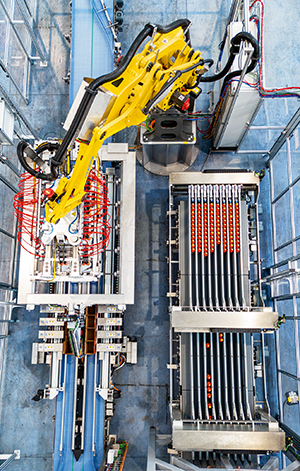
The variety of bottles and frequent changes in format pose a challenge here and demand maximum flexibility from the packaging line. Up to ten changeovers a day are not uncommon. With 24 bottle variants and 42 different packaging boxes, effective automation of the process is anything but simple. Despite this, Clevertech, a fast-growing family business that achieved sales of €250 million in 2024 and is based in the Italian province of Reggio Emilia, has managed to develop a solution that is as flexible as it is powerful. The XTS linear transport system from Beckhoff plays a central role.
Clevertech, which specialises in the design and construction of end-of-line systems for primary and secondary packaging, does not simply offer machines from a range in a catalogue. Instead, it analyses the customer’s needs in each case and develops an individual solution that meets their specific requirements on this basis.
Increased flexibility with XTS
“We have been working with this Dutch distillery for more than 20 years, and I have to admit that the request we received put our development department to the test,” explains Luca Carollo, business development manager at Clevertech.
The challenge was to drastically reduce the setup times of the end-of-line packaging system and increase productivity at the same time. These requirements forced Clevertech to completely rethink the automation of the entire line, including the design of the bottle gripper installed on a robot. The specialists at Beckhoff were contacted early on, right at the concept phase. “Although we were familiar with Beckhoff’s technologies, we had not yet carried out a project with them,” says Carollo.
The task was to develop a robot case packer that could handle a format changeover in just 7 minutes instead of the 30 minutes previously required, and that would also more than double the processing capacity from 110 to 225 bottles per minute. “Due to the limited space available, the floor space could not be increased,” says Carollo.
In addition to different bottle sizes, the machine has to adapt to the box formats, position the centering devices, and configure the grippers so that the bottles are placed in the correct sequence.
Mover mechanism developed in-house
This is exactly where the flexibility of the XTS makes the difference. With 24 XTS motor modules (AT2002-0250) and 32 magnetic plate sets (AT9001-0550 and AT9001-0AA0), Clevertech’s designers developed a special gripper head in a 12x4 matrix configuration. Thanks to the precise and synchronised control of the 32 movers, this structure makes it possible to grip bottles with different diameters, allowing the matrix dimensions to be adapted to the different box sizes on an ad-hoc basis, with options of 3x2, 4x3 or 6x4 bottles available, for example. “With XTS, it was possible to implement a solution that can process a wide range of bottles without having to change the mechanics of the grippers. This enabled us to simplify the machine’s design, something that brings even more advantages when it comes to construction, assembly and maintenance,” emphasises Carollo.
This case packer from Clevertech also features additional technical solutions which, together with the XTS, ensure a significant increase in productivity. One example is the positioning of the adjustable guides which form the infeed lines for the bottles of different thicknesses. These track widths are set automatically, depending on the bottle type.
Conventional systems that pack six bottles in 3x2 boxes, for example, typically have two infeed lines, with three bottles gripped from each. In contrast, the Clevertech gripper’s 12x4 matrix enables bottles to be gripped from up to four separate tracks simultaneously, doubling productivity.
23,000 more bottles per shift and increased safety
In the previous system design, the bottles were moved on the conveyor belts at up to 14 m/min in order to achieve sufficient processing speed. This sometimes led to broken bottles and glass splinters and unwanted machine downtimes. By doubling the infeed lines, Clevertech has been able to almost halve the belt speed of the new depositing system to a safe 7,8 m/min. This not only guarantees the integrity of the bottles, but also taps into opportunities for additional savings and sustainability projects, such as the use of thinner, and therefore more cost-effective, glass.
The reduction in machine downtime by 23 minutes per format changeover, together with the doubled packaging capacity, means that the customer can pack up to 23 000 additional bottles during one shift.
TwinCAT and XTS – a winning combination
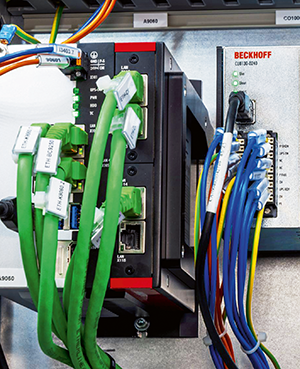
The TwinCAT runtime controls and synchronises the motion profiles and positioning of all 32 movers, and thus forms the heart of the automation solution. A C6032 ultra-compact Industrial PC with an Intel Core i processor and Windows operating system was selected as the controller. “The programming approach is very simple, almost instinctive,” states Roberto Sarzola, software developer at Clevertech, “The TwinCAT libraries provide all the functions we needed for the application.”
The precise synchronisation via EtherCAT and the real-time kernel of TwinCAT enabled highly dynamic application with very short cycle times and complete control of all speed and acceleration profiles. In addition, integrating logic, motion and safety functions in the same engineering environment simplified development, reduced configuration errors and sped up commissioning. “TwinCAT was the key for us to fully exploit the potential of XTS,” confirms Sarzola.
Customer satisfaction is the best reward
“The end customer is extremely satisfied with the work we have done, and as soon as all the tests have been completed, we are planning another line,” says Carollo. He says that automatic format changeover not only guarantees increased machine availability, it also eliminates the need for skilled workers to make mechanical adjustments. In a market where it is difficult to find qualified personnel, this is yet another advantage. According to Carollo, the improvements achieved are down to the engineering flair and technical skills of Clevertech’s designers. However, he adds that the experts at Beckhoff played a key role by providing targeted support and training.
| Tel: | +27 11 795 2898 |
| Email: | info@beckhoff.co.za |
| www: | www.beckhoff.com |
| Articles: | More information and articles about Beckhoff Automation |






© Technews Publishing (Pty) Ltd | All Rights Reserved
 printer friendly version