



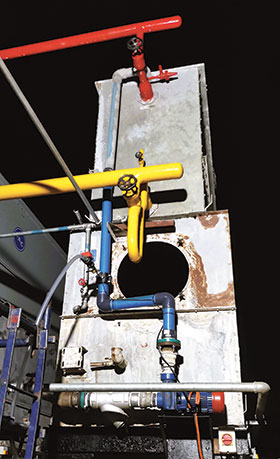
Cooling towers rely on evaporation to remove heat, but this process also concentrates dissolved solids in the system. Left unmanaged, this buildup can lead to scaling, corrosion and fouling, reducing efficiency and increasing maintenance costs.
“Without proper bleed control, dissolved solids accumulate over time and start to impact system performance,” says Anelia Hough, water treatment consultant at Allmech. “That’s why maintaining the right water balance is critical.”
Bleed, or blowdown, is the process of removing a portion of total dissolved solids/TDS from the system and replacing it with fresh make-up water. This helps keep dissolved solids within acceptable limits and supports the effectiveness of chemical treatment programmes. Hough says there are two main ways to manage this process:
• A time-based system, which uses a timer to open a valve at set intervals, discharging a portion of water regardless of actual water quality. “It’s a simple, reliable approach that doesn’t rely on probes or controllers,” Hough explains.
• A conductivity-controlled system, which measures the water’s conductivity as a proxy for TDS. When levels exceed a set threshold, the system automatically opens the bleed valve. “This allows for more precise control, because the system responds to real conditions rather than fixed intervals,” she says.
Weighing up the options
Each approach has clear trade-offs in terms of cost, control and complexity. Time-based systems are easy to install and operate, with lower upfront costs and fewer components. However, because they do not respond to real-time water conditions, they can be less efficient, and they may result in unnecessary water loss.
Conductivity-controlled systems require a higher initial investment and ongoing probe maintenance, including cleaning and calibration. In return, they offer tighter control over TDS levels, which can reduce water and chemical usage over time if maintained properly. “The right solution depends on your operating environment,” says Hough.
Time-based systems are typically suited to smaller installations or sites where water quality is stable and predictable. They also make sense where simplicity and low maintenance are priorities. Conductivity-controlled systems are better suited to larger or more complex operations, particularly where water sources vary or tighter control is required. “In some cases, a more advanced system is essential,” says Hough. “But in others, a simpler setup is not only sufficient, it’s more practical and cost-effective.”
Selecting the right valve for a time-based system
Hough says that valve performance plays a critical role in efficiency and reliability. Most time-based systems use solenoid valves which offer fast, precise actuation, but can be sensitive to fouling and wear, particularly in harsher water conditions. Regular maintenance and seal replacement are often required.
Allmech recommends ceramic ball valves for certain time-based bleed applications. “They are designed for durability,” she says. Their wear-resistant components perform reliably, even in abrasive or poor-quality water, with minimal maintenance over time. While actuation may be slower, the trade-off is longer service life, no water hammer and greater resilience.

Avoiding common pitfalls
Incorrect bleed settings can create their own problems. “Over-bleeding wastes water and chemicals, while under-bleeding allows dissolved solids to build up, increasing the risk of scaling, fouling and corrosion,” says Hough. “Even with a simple time-based system, you still need regular monitoring,” she notes. “Routine testing and periodic adjustments are essential to keep the system within safe limits.”
Ultimately, there is no one-size-fits-all solution. The choice between time-based and conductivity-controlled bleed systems depends on factors such as system size, water quality variability, budget and maintenance capacity. Hough suggests consulting with an experienced service provider for an objective assessment and recommendations. “With the right approach, operators can protect their equipment, reduce operating costs and ensure long-term system performance,” she concludes.
For more information contact Lionel Maasdorp, Allmech,






© Technews Publishing (Pty) Ltd | All Rights Reserved
 printer friendly version