October 2015Maintenance, Test & Measurement, Calibration
When steel surfaces are being prepared by abrasive blasting for hot dip galvanising and other protective coating applications, an assessment of the profile height is important in the surface preparation quality control procedures. This ensures that any profile specification requirement is met, as the area of the surface and hence the coating coverage or the hot dip galvanising process is affected by the profile height. For many years, analog gauges have been used to measure the profile peak-to-valley height.
Surface profile measurement
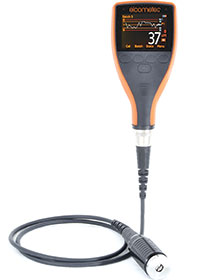
The Elcometer 224 digital surface profile gauge uses the well-proven method described in ASTM D 4417 method B. A conical, tungsten-carbide tip with a 60° angle and a 50 μm radius tip, locates the bottom of the valleys of the profile and the distance to the reference flat surface, formed by the foot of the gauge sitting on the peaks, is measured electronically and displayed for the user.
To set up the gauge for use, the measuring tip is aligned to the foot by placing the gauge on a flat glass slide and adjusting the gauge to read zero.
The gauge calibration condition can be simply verified by the operator using a ceramic reference shim with a circular hole cut for the tip to pass through. These shims are nominally 500 μm thick and the actual measurement is confirmed by taking three thickness measurements round the circumference of the hole using the average of the three readings as the actual value of the thickness of the shim. This value is recorded on a label that is attached to the shim. If any thickness value has a difference of more than 5 μm, in respect of the other values, then the shim is rejected.
If the gauge does not read zero on the glass slide and 500 μm on the ceramic reference shim then the gauge is not in calibration and should be returned for repair and recalibration.
The gauge is available in two software versions, Basic and Top and each version can be supplied with an integrated measurement assembly or a separate measurement assembly on a cable for difficult to reach areas. The cable can be standard or, if required, armoured for enhanced protection.
The Basic version displays the running statistical values, but does not have memory for the individual readings. The Elcometer 224 Top version has a memory for up to 150 000 individual readings in up to 2500 batches and has Bluetooth wireless communication to allow the batches of readings to be uploaded to a suitable PC for analysis, reporting and storage.
All four versions of the gauge have a range for profile height measurement of up to 500 μm and can take readings at a rate of more than 60 per minute with an accuracy of 5% of the reading or 5 μm, whichever is the greater.
Electrostatic spark discharge – when static strikes back Wearcheck
Maintenance, Test & Measurement, Calibration
WearCheck technical manager, Steven Lumley explains how static electricity accumulates in modern low-conductivity lubricants, why compact system designs and fine filtration make ESD more likely, and how to recognise the degradation it leaves behind.
Read more...High-speed cameras for crash testing Horne Technologies
Maintenance, Test & Measurement, Calibration
Vision Research has expanded its Phantom C-series with two cameras optimised for crash and safety testing, offering 4 and 8 megapixel sensors rated to 170G, up to 1180 frames per second, and Phantom Academy application training planned for South Africa next year.
Read more...SKF extends remanufacturing expertise to bearing clearance modification SKF South Africa
Maintenance, Test & Measurement, Calibration
Using its clearance modification expertise, SKF helped a mining equipment OEM salvage spherical roller bearing inventory that would otherwise have been scrapped, confirming a new capability within its remanufacturing services and avoiding redundant procurement.
Read more...When maintenance-system compliance starts replacing plant reliability Wearcheck
Maintenance, Test & Measurement, Calibration
WearCheck ARC division manager, Annemie Willer argues that the greatest threat to effective maintenance is no longer a lack of technology, but the gradual replacement of technical judgement by CMMS compliance, leaving no one owning the machine.
Read more...Nitration: the acid you didn’t see coming Wearcheck
Maintenance, Test & Measurement, Calibration
Nitration is as destructive as oxidation in many engines but far less understood. WearCheck technical manager, Steven Lumley explains how nitrogen oxide gases degrade lubricants, why the process is difficult to detect, and what oil analysis can reveal before damage occurs.
Read more...KSB makes mechanical seals for its own pumps and other brands
Maintenance, Test & Measurement, Calibration
KSB Pumps and Valves is expanding its range of mechanical seals to fit its own pumps and competitor brands. The portfolio covers component and cartridge seals, API 682-compliant systems, slurry and high-pressure seals, and ATEX-certified solutions, supported by refurbishment and field service capabilities.
Read more...Omniflex delivers ICCP systems in London Omniflex Remote Monitoring Specialists
Maintenance, Test & Measurement, Calibration
Omniflex has supplied impressed current cathodic protection systems for landmark London buildings, protecting reinforced concrete from corrosion and extending the service life of commercial, retail and heritage sites.
Read more...Modernising acid cooler protection without disrupting production Omniflex Remote Monitoring Specialists
Maintenance, Test & Measurement, Calibration
Omniflex has supplied an advanced anodic protection control system to phosphate producer Foskor, replacing a legacy transformer rectifier system while maintaining uninterrupted production. The distributed PowerView CP solution provides remote monitoring and DCS integration.
Read more...Engineering partnership delivers longer life for vibrating feeders in mining
Maintenance, Test & Measurement, Calibration
OST-Africa’s combination of VISAM vibrating motors and advanced rubber mounting technology has helped Euro Sales achieve a 30 to 40% increase in component life on vibrating feeders at several major mining operations, with zero mount failures in the first 12 months.
While every effort has been made to ensure the accuracy of the information contained herein, the publisher and its agents cannot be held responsible for any errors contained, or any loss incurred as a result. Articles published do not necessarily reflect the views of the publishers. The editor reserves the right to alter or cut copy. Articles submitted are deemed to have been cleared for publication. Advertisements and company contact details are published as provided by the advertiser. Technews Publishing (Pty) Ltd cannot be held responsible for the accuracy or veracity of supplied material.










 printer friendly version