

IT in Manufacturing


New browser based groov from Opto 22

May 2013 IT in Manufacturing

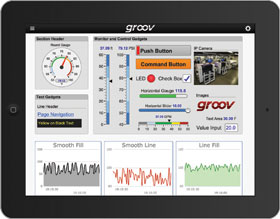
Opto 22 has announced groov, a new way to build, deploy, and view simple, effective, and scalable operator interfaces to monitor and control systems and equipment using computers and mobile devices. Using only a modern web browser, groov lets industrial automation end-users, system integrators, machine OEMs, building managers, technicians, or any authorised person, to build and deploy browser-based interfaces for automation, monitoring, and control applications. These operator interfaces can then be viewed on almost any computer or mobile device regardless of its manufacturer or operating system, including PCs, tablets, smartphones and even smart high-definition televisions. groov is intended to augment traditional human-machine interfaces (HMIs) by making important information available at any time and in any location.

groov reduces the time, complexity, and cost usually associated with mobile HMI development by operating completely within a modern web browser and running on a secure and industrially hardened network appliance. It offers a simple yet flexible environment for developing operator interfaces with zero programming and requires no per-seat runtime or viewing licences. Overcoming the biggest challenge in developing for multiple screen sizes, groov automatically scales all screens, page objects and gadgets, allowing HMIs to be viewed and manipulated from virtually any device of any screen size.

Working with modern web browsers like Internet Explorer, Firefox, Chrome, Safari, or Opera running on operating systems including iOS, Android, Microsoft Windows, Mac OS, and Linux, groov benefits from the capabilities of these browsers by using the latest web standards like HTML5, CSS3, and SVG. And while many competing technologies depend on additional software or browser plug-ins like Flash, Silverlight, or Java to work, groov requires no additional software or plug-ins, simplifying deployment.

Networking and interface development

The heart of the groov system is a secure industrial appliance called the groov Box, which runs the groov software. All network communication between a web browser and the groov Box uses an encrypted secure sockets layer (SSL) over an HTTPS connection. The groov Box does not respond to any other communication methods on any other ports.

groov connects to Opto 22 SNAP PAC automation systems and OptoEMU energy monitoring products over a separate and segmented wired or wireless Ethernet network, adding a secure barrier for control systems. Support for the OPC-UA protocol is planned in 2013 and will allow groov to communicate with systems from other manufacturers that offer an OPC-UA server.

The simple and flexible development environment, groov Build, dramatically reduces the time needed to build interfaces when compared to traditional HMI screen building tools. groov Build includes a library of scalable, touch screen gadgets: gauges, buttons, range indicators, text entry, sliders and trends. Images and real-time video from network IP cameras can also be added. Designed to support HMI best practices, groov Build includes the tools necessary to build high-performance, intelligible information and control screens like those defined by the High Performance HMI Handbook (Hollifield et al.) and the ASM (Abnormal Situation Management) Consortium Guidelines, Effective Operator Display Design.

groov components

The groov system includes the groov Box, groov Build, groov View, and the optional apps groov View for iOS and groov View for Android.

* groov Box is a small-footprint network ­appliance designed for industrial environments; it interfaces with control systems and runs the groov software. The groov Box includes three separate, independent network interfaces: two 1-Gbps Ethernet interfaces and one 802.11b/g/n wireless interface.

* groov Build is the software used to create an interface in a browser.

* groov View is the software used to run an interface in a browser.

* groov View for iOS and groov View for Android are optional free apps that display the operator interface full screen and without browser menus. These apps make an interface look like a native app for the device, and are ideal for mobile devices used in kiosk applications.

For more information contact Mike Harrison, Opto Controls, +27 (0)11 792 5232, [email protected], www.opto.co.za


Credit(s)


Share this article:
Share via emailShare via LinkedInPrint this page

Further reading:

Overcoming the bottling industry’s fragmented visibility
Schneider Electric South Africa IT in Manufacturing Electrical Power & Protection
Beverage bottling facilities are among manufacturing’s most energy-intensive environments, yet many still operate without granular insight into where that energy goes. Rezolia Muller-Potluri of Schneider Electric explains how tiered metering architecture and advanced

Read more...
Advancing intelligent apparel manufacturing with industrial AI and humanoid robotics
IT in Manufacturing
Jack Technology, a global maker of industrial sewing equipment, has chosen Siemens software and engineering tools to bring artificial intelligence and humanoid robots into apparel production, aiming to shorten development cycles and lift manufacturing efficiency.

Read more...
New chiller line for high-density AI data centres
Schneider Electric South Africa IT in Manufacturing
Schneider Electric has launched the Uniflair XCA, a new series of air-cooled and free-cooling chillers designed for artificial intelligence-driven, high-density liquid-cooled data centres.

Read more...
Turning system integrators into trusted technology partners
Schneider Electric South Africa IT in Manufacturing System Integration & Control Systems Design
Schneider Electric’s Alliance Partner Programme is repositioning system integrators from hardware suppliers into lifecycle-value partners. Oriel Soupen explains the competency framework, certification model and real-world results that are already helping African system integrators win higher-value, longer-term engagements.

Read more...
Why renewable projects need integrated protection and control
IT in Manufacturing
Fragmented secondary plant integration in renewable energy projects causes costly delays during commissioning. ACTOM Protection and Control’s Secondary Plant Integration solution consolidates all secondary systems under a single engineering framework, reducing risk and accelerating grid

Read more...
When digital twins move from concept to critical tool
IT in Manufacturing System Integration & Control Systems Design Maintenance, Test & Measurement, Calibration
Digital twins are moving out of the lab and onto the mine, the factory floor and the transport network where they predict failures before they happen. Amritesh Anand looks at where they earn their keep, the data and integration work behind them, and the security questions every organisation should ask before switching one on.

Read more...
How a digital foundation can overcome the LNG trilemma
Schneider Electric South Africa IT in Manufacturing SCADA/HMI
The LNG sector is racing to add capacity, but without a digital backbone, growth creates complexity rather than capability. Christophe Begat of Schneider Electric explains how connecting data, systems and analytics across the LNG value chain can resolve the trilemma of secure supply, lower emissions and tighter costs.

Read more...
Decarbonisation is reshaping mining strategy in Africa
Schneider Electric South Africa IT in Manufacturing Electrical Power & Protection
Mining companies across Africa are embedding decarbonisation into operational strategy, driven by investor, regulatory and customer pressure to reduce emissions while improving resilience.

Read more...
Siemens and HighByte partner to scale industrial AI
Siemens South Africa IT in Manufacturing Fieldbus & Industrial Networking
Siemens is expanding its Industrial Edge ecosystem through a partnership with HighByte, enabling customers to connect, contextualise and transform data from operational technology and information technology sources to build AI models and applications at scale.

Read more...
Africa on the edge of a digital future
Schneider Electric South Africa IT in Manufacturing
Edge computing promises lower latency, stronger reliability and real-time responsiveness across Africa, yet its rollout keeps colliding with one stubborn obstacle, power. Steven Santini explores how renewable microgrids, smart energy management and the right partnerships could turn the continent’s energy gap into its biggest edge opportunity.

Read more...


While every effort has been made to ensure the accuracy of the information contained herein, the publisher and its agents cannot be held responsible for any errors contained, or any loss incurred as a result. Articles published do not necessarily reflect the views of the publishers. The editor reserves the right to alter or cut copy. Articles submitted are deemed to have been cleared for publication. Advertisements and company contact details are published as provided by the advertiser. Technews Publishing (Pty) Ltd cannot be held responsible for the accuracy or veracity of supplied material.


© Technews Publishing (Pty) Ltd | All Rights Reserved