Controlling static electricity
May 2003
Maintenance, Test & Measurement, Calibration
As the automotive industry continues its change from metal to engineered plastics for many components, one persistent problem is static electricity on the plastic surfaces. Static results in poor-quality finishes and dust entrapment in plastic assemblies. Poor finish is particularly abhorrent to this appearance-conscious industry.
Very simply, static electricity occurs whenever two materials are mechanically worked together, or when two materials in contact are separated rapidly. Through a process called tribo-electrification, electrical equilibrium is disrupted. One material loses electrons to become positively charged while the other gains them to become negatively charged. The material's conductivity determines its ability to pass along this charge. Good conductors, such as metals, can lose a static charge almost immediately. Insulators, such as plastics, retain their static charge - sometimes for weeks.
Many normal handling operations generate static. These include parts moving on conveyor belts, sliding down chutes, or simply rubbing against each other. In fact, manual cleaning with tack rags or using a compressed air blow-off to remove visible dirt will impart an invisible static charge to attract and hold more dirt as the part travels through the production pipeline.
Three basic approaches can eliminate static charges:
* Climate control - particularly temperature and relative humidity - in the work area.
* Applying conductive media to the charged surface.
* Ionising the air around the working surface.
Climate control often proves logistically difficult and expensive. Conductive coatings may be detrimental to the product and other processes. Ionising the air does not alter the material or its surface, and therefore has become the option of choice for neutralising static on plastic surfaces. (For many years, ionising has performed in the printing and converting industries where extremely high static charges are encountered as paper and cardboard are processed through presses and forming machines.)
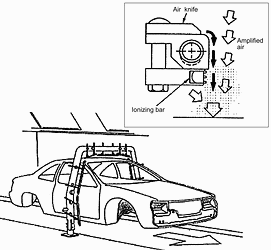
One system to fight static is the Typhoon+ that combines electrical ionisers with air knife amplifiers to clean and neutralise plastic and other surfaces prior to painting or other finishing operations. Typically, the ioniser consists of a bar with rows of very sharp pins. The bar's configuration and length varies with the application. When electrically charged from 5 to 10 000 V, the pins create a high-potential gradient at their tips which overstresses and ionises the air in the region.
Amplified compressed air streams deliver ion clouds to neutralise static electricity on automobile surfaces prior to painting and finishing operations
The air knife amplifier - from Ex-air Corp, Cincinnati - uses a small volume of filtered compressed air as its power source. The knife discharges this compressed air through a 0,002" gap along its length, generating high-velocity, laminar pneumatic flow that pulls in large volumes of ambient air. Amplification ratios entrained-air/compressed-air - can run as high as 30:1.
The high-volume air stream passes over the electrical ioniser mounted at the bottom of the knife, capturing much of the ion cloud, and delivering to the work surface, which can be up to 15 ft away. The ions neutralise static charge and the air also scrubs and cleans the surface. Because of the amplification factor, the air knife consumes much less energy than blow guns or other types of airborne systems.
When combined with sensors and valving in a production situation. Typhoon+s provide a simple, inexpensive, and safe answer to static electricity problems.
For more information contact E-Test, 031 702 8302.
Further reading:
Operational efficiencies and safety compliance with preventive maintenance programmes
Maintenance, Test & Measurement, Calibration
Konecranes explains how its Lifecycle Care Preventive Maintenance programme reduces unexpected downtime, improves safety compliance and delivers measurable financial benefits for operators of cranes and lifting equipment across any make or sector.
Read more...
Portable appliance tester
Vepac Electronics
Maintenance, Test & Measurement, Calibration
Vepac Electronics’ new portable appliance tester enables precise safety testing of electrical appliances in accordance with DGUV regulation 3 and BetrSichV, with simple three-button operation and battery-powered mobility.
Read more...
Why lubrication fails in mining and what to do about it
Maintenance, Test & Measurement, Calibration
Lubrication Engineers explains the recurring failure points behind mining lubrication problems and how the right product, storage and application practices can improve equipment reliability.
Read more...
When digital twins move from concept to critical tool
IT in Manufacturing System Integration & Control Systems Design Maintenance, Test & Measurement, Calibration
Digital twins are moving out of the lab and onto the mine, the factory floor and the transport network where they predict failures before they happen. Amritesh Anand looks at where they earn their keep, the data and integration work behind them, and the security questions every organisation should ask before switching one on.
Read more...
Why asset level intelligence is now essential for resilient wastewater plants
Schneider Electric South Africa
Maintenance, Test & Measurement, Calibration
Sub-Saharan Africa’s wastewater operators face mounting pressure to keep ageing plants running smoothly and meet tougher environmental standards, all while lacking visibility into the health of their medium-voltage (MV) drives and other critical rotating assets. Adding predictive analytics, digital twins and enterprise dashboards enables optimisation across multiple sites, ensuring every drop moves safely and efficiently through the water cycle.
Read more...
How multiple boilers can minimise costly downtime
Maintenance, Test & Measurement, Calibration
Associated Energy Services explains how multi-boiler systems reduce downtime risk for South African manufacturers, covering redundancy planning, fuel source diversification and the strategic management of backup boiler capacity.
Read more...
Field calibration made easy
Instrotech
Maintenance, Test & Measurement, Calibration
Instrotech’s locally designed and manufactured Calog calibrator range feature a rugged IP54-rated housing, backlit display with data logging via SD card, and a lithium-ion battery with approximately eight hours of run time.
Read more...
Repair and maintenance services boost system efficiency by 30%
Maintenance, Test & Measurement, Calibration
Following the expansion of its local sales and services network, Rittal South Africa continues to offer comprehensive onsite installation, repair and maintenance services to customers nationally.
Read more...
Keeping lifting equipment safe and securely on track
Maintenance, Test & Measurement, Calibration
In the hustle and bustle of mining production, the focus on the servicing of lifting equipment can unintentionally be sidelined. This situation can easily be avoided with a customised Konecranes Service Agreement that offers a comprehensive and systematic approach to asset management.
Read more...
Tablet oscilloscope
Vepac Electronics
Maintenance, Test & Measurement, Calibration
The PeakTech 1212 is a new, innovative oscilloscope designed to resemble a standard tablet in size and form. This tablet oscilloscope allows users to record any common measurement quantity and type, just like a desktop oscilloscope.
Read more...










 printer friendly version