



Abacus Automation is one of the top Siemens system integrators (SIs) in this country. SA Instrumentation & Control’s editor caught up with sales manager and director, Nico Erasmus to find out more.
Abacus completes about 50 projects a year, both locally and internationally. These vary in size from Micro PLC applications to multimillion-Rand projects involving large drives, multiple PLCs, scada and automation components. As a member of the Siemens global solution partner programme, the company has been involved in dozens of joint venture projects with Siemens. It has received many accolades, including awards for the best project and the most innovative project for four consecutive years over the more than 20 years as a Siemens Solution partner. The company became the first Siemens Motion Control Cranes solution partner in Africa, adding to its existing solution partner portfolio.
With a reputation for innovative software and creative use of automation hardware, Abacus is going from strength to strength. Erasmus shares his thoughts below on how Abacus operates, and the system integrator landscape in South Africa.
The current situation
There have been a lot of shake-ups in the industry after the upheavals in recent years, and industry is having a harder time in the comeback than the commercial sector. We used to compete against OEMs from Europe to bring in new machines and work with local manufacturers. Where that used to be the majority of our business, this has become less than a third of our projects. We are now more involved with helping customers extend the life of their existing machines by upgrading their control systems; and if they buy a new machine, they are more likely to replace two old machines with one new one capable of operating at least twice the speed to save on labour. Other key impacts also include the effects of loadshedding.
Loadshedding
Loadshedding has helped the local market from a SI point of view. Older equipment can’t tolerate a frequent off-on environment, and this is forcing a lot of customers into doing upgrades because their equipment is failing, not only because of the loadshedding, but also because the electronics are old and they need to keep the plant working. Older equipment also tends to be less energy efficient, something often not sufficiently addressed during upgrades.
Energy efficiency
People are concerned about energy efficiency as long as they’re talking about it while sitting in an air-conditioned office or around a table with a nice hot coffee. But once you get out on the factory floor, it’s production and costs that count.
I think a lot of people are confused about the concepts of energy efficiency and green energy. They are two completely different things. Solar doesn’t make your factory more energy efficient. You’re just getting your power from a different place and that’s helping you bring your costs down. If people put some covers on their heating tunnels and added an extra layer of insulation, they’d use less electricity, but this is not always as easy to quantify.
The specific challenges of an SI
Considering these shifts in local market dynamics, the challenges of SI’s differ from those of a straight manufacturer. Apart from needing passionate staff, we are smaller, have to be more adaptable, and offer a higher level of service. We have to be on top of our game and the latest developments all the time. We need to push the boundaries because we have to be more innovative than our competitors to be able to win projects.
The opportunities
The drive for innovation means that you need to look at how you can take an existing piece of equipment for a customer and make it as close to efficient as a new one would be. So you’re not just ripping out the old controller and putting in a new one. You’re also looking at how to use the opportunity to generate more income for your customer and get more production out of the existing line.
Our philosophy
Our philosophy has always been that a customer must deal with you because they want to, not because you painted them into a corner and they now have to deal with you. Sometimes we just don’t have anyone who can help a customer get a plant running, and then we need to call on a competitor to assist. But we know that the customer will come back to us because of our passion. We don’t have a big sales force, because everything we do and the opportunities we get come from word of mouth and return customers.
Getting into cranes
In 2012, Siemens approached us to consider moving away from Micro PLCs into motion control and cranes. It took us several years to become fully certified for Siemens crane automation solutions, but this is what is keeping us going at the moment. We have done jobs on cranes in harbours in South Africa, Djibouti, Kenya, and Reunion Island. This has become key to our business, because the local economy just isn’t strong enough for all of the players in the market. Business outside our borders is keeping many solution partners afloat at the moment.
Growing our people
This has allowed us to invest in growing our people. Despite the economy being in a really tough spot, we are actually short-staffed. The biggest challenge is not to find someone looking for a job, but someone who is passionate about our type of engineering.
There’s a huge disconnect between the needs of big industries compared to SIs and solution partners with respect to the skills we require. A stream of students finish their studies each year, but big industry can’t take them up. Smaller companies have the capacity, but the students studies and know-how aren’t geared to the needs of solution partners and SIs.
We’re now working on approaching things from a completely different angle. Trying to look for schoolkids where there’s a passion starting to shine through. If we can catch them early, we can grow that interest and nurture them into the type of engineers that SIs really need. Our strategy is to take youngsters with no experience into a support role so they can start learning how the technical field works, and then slowly grow them into a technical role.
We are finding that graduates come out with a qualification on paper, but from a laboratory environment. They know all the equations, but they can’t get a plant to run. We’ve seen it at Abacus. As much as our guys like to get behind a laptop, we need them to understand how a load cell or a valve or a motor works. They must be able to strip it apart and fix it if it’s broken. We put a lot of effort into giving our students hands-on skills. This helps them understand the mechanics, because at the end of the day if you write software, all it does is control the mechanics. If you don’t understand the mechanics, how will you know how to write your software correctly? If we can get that right, I think there’ll be a big change in how our industry works together. I don’t know how we’re going to make it happen on a large scale, but if we can make it work on a smaller scale, and share our experience who knows what can happen...
Our target markets
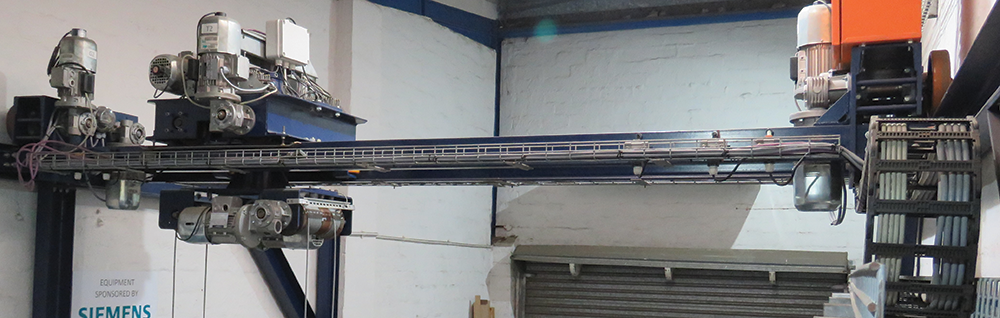
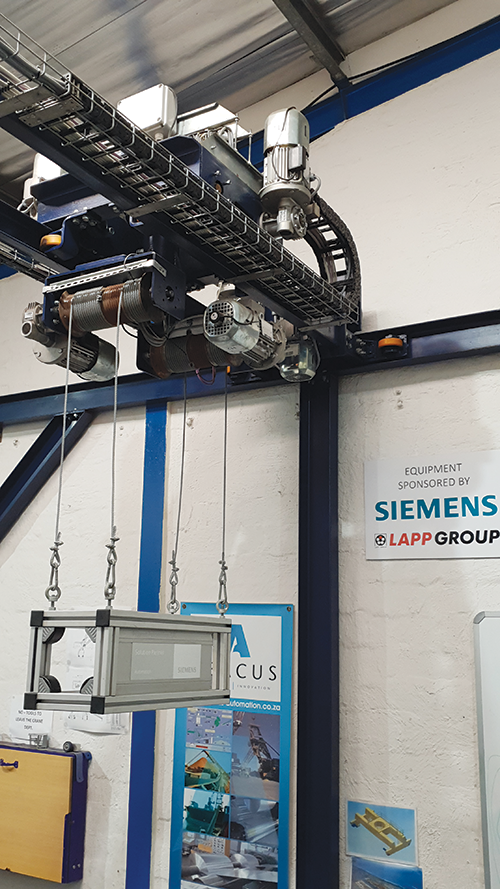
Back to cranes, it has become a really big portion of our market, together with bigger motion control machines. In 2016 we built a full seven-axis research and development crane in our workshop. It’s running the full Siemens Simocrane solution on the crane management system. At the time we built it so that we could teach ourselves, but later we realised its value in our African market.
Now when we do a factory acceptance test, we download the software to the crane and can physically operate it. Customers can come in, sit in the seat, and actually operate the crane themselves and see what it does. This has opened up the door to opportunities all over the continent. We’ve even got one of our former students starting up a business in the Congo affiliated with Abacus to help grow business in that region.
Highlights of the year
A highlight for us is an upgrade on a Gottwald crane in Eritrea. These are notoriously difficult cranes to upgrade, so much so that Siemens required several technical meetings with us before allowing us to go ahead. This showed that Siemens is willing to trust us to tackle an upgrade like this. We used our in-house crane to get ourselves up to the necessary skill level. I think that’s also a show of faith in how high our technical level and capabilities are.
The next five years
Our biggest focus is to get the rest of Africa to know about us so that we can help refurbish cranes and extend their lifespans. We’re all part of the same continent and we need to help each other where we can to reduce our dependence on other continents for our progress.
There is more, to read the full Abacus story visit www.instrumentation.co.za/ex/abacus.pdf
| Tel: | +27 31 702 5767 |
| Email: | [email protected] |
| www: | www.abacus-automation.co.za |
| Articles: | More information and articles about Abacus Automation |






© Technews Publishing (Pty) Ltd | All Rights Reserved
 printer friendly version