



Environmental monitoring and process control.
Keywords: [acid mine drainage, EIA, EMP, environmental impact assessment, environmental monitoring, GEOSS, geospatial, GRI, instrumentation, interoperability, Krugersdorp Basin, mashup, OGC, pollution, process control, Python, Sensors Anywhere, Sensor Web Enablement, SOS, standards, SWE, TransducerML]
Adding geospatial information to measurement data provided by instrumentation provides new and valuable insights for environmental monitoring. Could this become pervasive in process control?
Abstract
This paper explores the potential of sensor web enablement for environmental monitoring and process control, illustrated by a mine environmental monitoring prototype in the Krugersdorp Basin, a mineral processing process control concept and a mining operations management concept.
The task of measuring and interpreting environmental and process variables is becoming increasingly large and complex. Many proprietary and open technologies are in use for observing, communicating, analysing and reporting these variables.
Several international initiatives have created the conditions for interoperability among these systems at technical, organisation, semantic and political levels. Examples include the Global Earth Observation System of Systems, the Open Geospatial Consortium’s (OGC) Sensor Web Enablement (SWE) initiative and the Semantic Web.
Sensor Web Enablement allows for the integration and analysis of streams of sensor data from multiple and diverse sensors in a standards-based and thus interoperable manner.
For instance, observations from water quality sensors can be fused with those from weather instruments and satellite remote sensing instruments. Measurements of anything from process or biophysical variables to higher level indicators such as re-vegetation or landscape function and even social impact potentially can be sensor web enabled.
Collection, management and analysis of these data can be automated and adaptive, handling the disruption of service from some sensors or the addition of new sensors.
Sensor web enablement of mines and their entire footprints ultimately can enable greater understanding of the systems at play by capturing their dynamics in time and space.
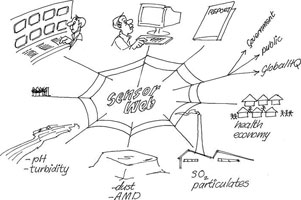
In the Krugersdorp Basin, disused gold mines, whose groundwater is no longer being pumped out, are overflowing at several egress points. Acid mine drainage is contaminating surface and groundwater over a large area. Water quality and quantity sensors have been placed in six clusters throughout the system in an attempt to characterise it, monitor compliance and to flag events that need urgent attention, such as flow pulses or dips in pH.
In a sensor web enablement prototype, these sensors have been exposed through an OGC SOS (sensor observation service), described by OGC SensorML (sensor model language) and visualised in an SOS graphing client.
Introduction
Modern mine monitoring requirements are discussed and challenges in achieving these are raised. Increasingly complex, onerous and costly monitoring requirements necessitate a new approach to monitoring. Technically, organisationally and semantically isolated monitoring systems dominate in the industry. These are generally provided by competing proprietary vendors.
An emerging concept called sensor web enablement (SWE) is introduced and described. SWE results in interoperable monitoring systems with less redundancy and wider application. The application of SWE in mine environmental monitoring is explored, focusing on aspects of closure and rehabilitation. An example of SWE of a water monitoring system in a closure situation near Krugersdorp is presented to demonstrate some SWE concepts.
Continued on the web
For the complete article visit www.instrumentation.co.za/+C9202

For more information contact Gavin Fleming, Mintek, +27 (0)11 709 4668, [email protected], www.mintek.co.za






© Technews Publishing (Pty) Ltd | All Rights Reserved
 printer friendly version